Habermas (cited in McKee 2005, p.6) explains the public
sphere as “A domain of our social life where such a thing as public opinion can
be formed [where] citizens…deal with matters of general interest without being
subject to coercion…[to] express and publicise their views.”
Carpignano (cited in McKee 2005, p. 7) notes that the idea of the public sphere was born in the 17th century as “the outrageous concept that every person in society should be treated equally” emerged. So in the 17th century the public sphere was a physical space where people from all backgrounds could have their say on matters that were of interest in the town they were in. Fast forward to now and the virtual world of Web2.0 and we have the new virtual public sphere or Blogosphere.
Blogs allow people of all walks of life (as long as they have an internet connection) to let loose on what they think on particular topics. Bloggers also have the opportunity to engage in debates via the comments section on issue they may have differing opinions on. There is proof of minorities having their say as well as a study into the 2007 election showed minor blogs were dominant in putting their opinion forward (Bruns, 2010, pg. 281). Bruns continues through to mention blog readers follow a flow as these minor blogs link to major blogs which in turn have linked to mainstream media giving the less powerful less of a voice (2010, pg. 282).
If
we move to social media we can see the like of Facebook, Twitter and YouTube
giving voice to minorities again but are these opinions healthy and evidence
based debates? Bruns explains (2010, p. 285) that in order to engage in public
discussion a person must put their social, personal and lived experiences
aside. This allows for a legitimate public debate but looking over my Twitter,
Facebook and YouTube accounts not much of that is happening.

The public sphere
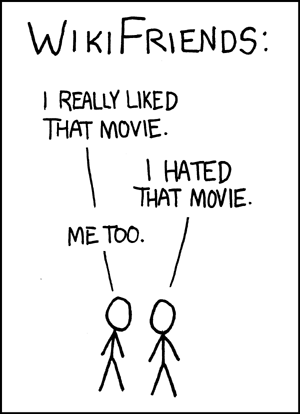
in the virtual world is a sphere of ‘Trolling’ where attacks and opinions are
made based on social or personal feelings. If in the odd chance you come across
a legitimate debate, you’ll be sure to find someone arguing based on
illegitimate factors. In essence, the traditional public sphere is in hiding.
References
Bruns, A, Burgess, G, Highfield, T, Kirchoff, L &
Nicolai, T 2010, ‘Mapping the Australian Networked Public Sphere’, Social Science Computer Review, vol. 29,
no. 3, retrieve 30 August 2013, <http://ssc.sagepub.com/content/29/3/277>
McKee, A 2005, The
Public Sphere, Cambridge University Press, retrieved 30 August 2013, <http://equella.deakin.edu.au/deakin/integ/gen/f1dcb0d5-236b-dd38-3359-3597f69442c1/1/?attachment.uuid=3aeb835b-3ead-4973-84b2-245b66813ea7>

An interesting insight into the presence (or lack of?) of the public sphere in the online world. Your inclusion of Habermas' definition of the public sphere was well applied to todays online world of blogging and social media. I similarly think that while social media platforms are providing the opportunity for many to communicate on a global scale, majority of people are lost in the wealth of information online. Overall, a great analysis of the potential for social media and the blogosphere to function as a limited public sphere.
ReplyDeleteHey Christopher,
ReplyDeleteThis blog has been excellently put together. I completely agree that in the virtual public sphere is made up of ‘trolling’. Habermas’s perceived public sphere suggests that rational & educated people engage in open discussion. Unfortunately this doesn’t happen online. The Internet allows everyone access to the ‘blogosphere’ and not everyone is rational and educated. Often (as I have found) people respond emotionally and unreliably. Perhaps someday in the future the blogosphere will become the ideological beacon for open discussion, however I believe it is a long way off. Keep up the awesome work!
Hey Chris!
ReplyDeleteYour blog was constructed in a very engaging manner. I really enjoyed how you quickly touched upon the evolution of the 'public sphere' in comparison from the 17th century through to now. Trolling is also a point that I am glad you mentioned. This occurs on a daily basis and the frequency of an individual who is putting forth views based on 'illegitimate factors' is quite alarming.
All in all, a very enjoyable piece supported by great imagery and underlined with an excellent use of references. Keep it coming, great work!
Hi Chris,
ReplyDeleteYour piece flowed well, however would have benefited from the use of hyperlinks, for example when you mentioned the 2007 election and 'trolling'. Political blogging, social media and trolling are all good ways to exemplify the concept, however if you had focussed on just one you might have been able to provide more in-depth discussion.
A considerable strength of your piece is that you showed evidence of wider reading, drawing on more than just the set reading. The opening paragraph of the piece was strong and set the tone, linking Habermas' idea of the public sphere to the blogosphere.
Good work!
A very interesting view of the online public sphere (or lack there of). The inclusion of Habermas really strengthened your argument and I feel it really applies to today's online world of social media. I also agree with your view that the online realm is simply a place for 'trolls' to roam, and again strengthens the point you are making. The internet doesn't have a filter to stop simply anyone going online and posting, and this links Habermas' ideas to the blogosphere. Great work.
ReplyDelete